
Artificial Intelligence (AI)
AI can be categorized into three main types based on its capabilities:
1. Weak AI (Narrow AI)
- Definition: AI designed to perform a specific task extremely well but cannot go beyond its predefined functions.
- Characteristics:
- Limited to one domain.
- Cannot think or reason outside its programming.
- No self-awareness.
- Examples:
- Voice assistants (Siri, Alexa, Google Assistant).
- Netflix or YouTube recommendation systems.
- Spam email filters.
2. Strong AI (General AI)
- Definition: AI that has the ability to understand, learn, and apply intelligence across a wide range of tasks — just like a human being.
- Characteristics:
- Can perform multiple functions, not limited to one domain.
- Capable of reasoning, problem-solving, and decision-making.
- Learns and adapts autonomously.
- Examples:
- Still theoretical — we don’t have true General AI yet.
- Research projects like OpenAI’s GPT models are considered early steps.
3. Super AI (Artificial Superintelligence)
- Definition: AI that surpasses human intelligence and can outperform humans in every field — creativity, decision-making, problem-solving, and even emotions.
- Characteristics:
- Higher intelligence than the best human minds.
- Possesses self-awareness and consciousness.
- Could independently innovate, make scientific discoveries, or even make ethical decisions.
- Examples:
- Purely hypothetical/futuristic (not yet achieved).
- Often discussed in science fiction and AI ethics debates.
✅ Summary in one line:
- Weak AI = Task-specific AI
- Strong AI = Human-like AI
- Super AI = Beyond human intelligence
Human vs Artificial Intelligence
1. Origin & Nature
- Human Intelligence:
- Naturally evolved through biology.
- Based on emotions, experience, and consciousness.
- AI:
- Man-made, created through algorithms and data.
- Works on logic, programming, and patterns.
2. Learning Ability
- Human Intelligence:
- Learns from life experiences.
- Can apply knowledge in different situations (flexible learning).
- AI:
- Learns only from given data (machine learning).
- Struggles outside its training (narrow focus).
3. Creativity & Innovation
- Human Intelligence:
- Highly creative, can imagine new ideas, art, and inventions.
- Driven by emotions, curiosity, and culture.
- AI:
- Limited creativity (creates based on existing data).
- Can generate content (images, music, text) but lacks true imagination.
4. Decision Making
- Human Intelligence:
- Considers logic + emotions + ethics.
- May be biased or subjective.
- AI:
- Decisions purely data-driven and logical.
- Faster but can be biased if trained on biased data.
5. Speed & Accuracy
- Human Intelligence:
- Slower in calculations and data analysis.
- Can make mistakes due to fatigue or emotions.
- AI:
- Super-fast in processing huge data.
- High accuracy in repetitive tasks (e.g., medical scans).
6. Adaptability
- Human Intelligence:
- Highly adaptive, can switch domains easily.
- Uses intuition to solve unknown problems.
- AI:
- Narrow AI is rigid (good at one task).
- General AI (still theoretical) would be more adaptive.
7. Emotions & Ethics
- Human Intelligence:
- Driven by emotions, empathy, values, and morality.
- Can make compassionate choices.
- AI:
- No emotions or morality (unless programmed).
- Ethical decisions are still a major challenge.
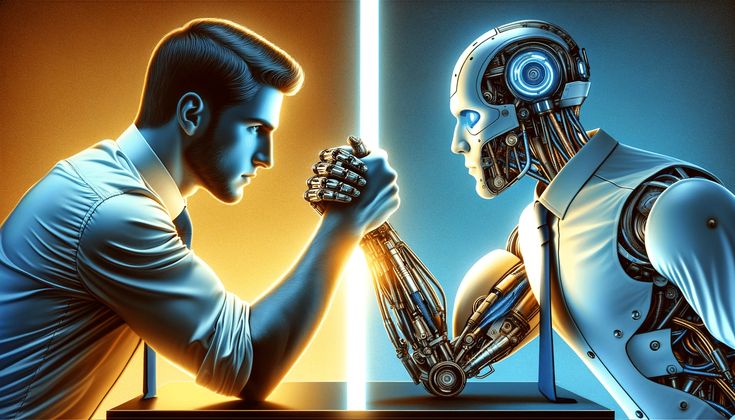
| Aspect | Humans 🧠 | AI 🤖 |
|---|---|---|
| Origin | Natural, biological | Man-made, programmed |
| Learning | Experience + intuition | Data + algorithms |
| Creativity | Original & imaginative | Based on patterns, limited |
| Decision-making | Logic + emotion + ethics | Data-driven, fast but limited |
| Speed | Slower, error-prone | Very fast, accurate |
| Adaptability | High, across domains | Low (for now, except theoretical General AI) |
| Emotions | Present (empathy, morality) | Absent (can simulate but not |
How AI Can Harm Humans
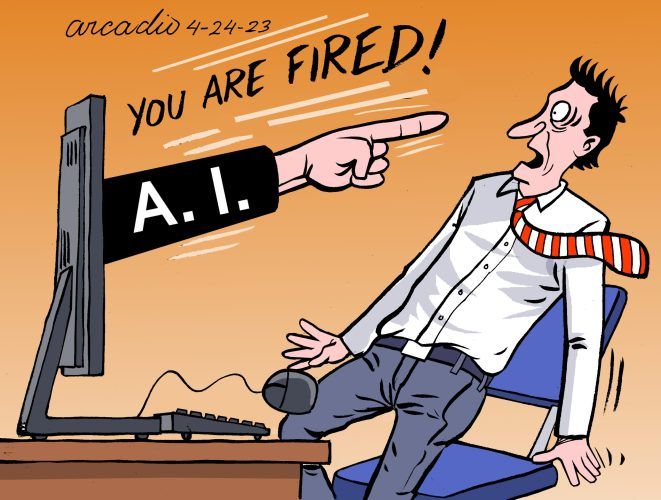
1. Impact on Jobs
- AI machines and robots can do human tasks faster and more accurately.
- This may lead to job losses, especially in areas like data entry, call centers, factories, and transportation.
2. Skill Gap
- With AI, new skills (like Data Science, Machine Learning, Prompt Engineering) are in demand.
- People without these skills may fall behind.
3. Privacy Risks
- AI collects and analyzes huge amounts of personal data.
- If misused, it can lead to privacy violations and misuse of personal information.
4. Fake Content & Misinformation
- AI can easily create fake news, deepfake videos, and misleading information.
- This makes it easier to deceive people or spread propaganda.
5. Reduced Human Thinking
- If AI handles everything, humans may become less creative and less problem-solving over time.
6. Control & Security Threats
- If AI becomes too powerful (Super AI), humans may lose control.
- In military use, AI-based weapons could be a major danger.
7. Lack of Emotions & Ethics
- AI has no feelings or moral values.
- If misused, it can make decisions that are harmful to people.
✅ Summary
The main harms of AI to humans:
👉 Job loss
👉 Skill gap
👉 Privacy risk
👉 Fake information
👉 Reduced creativity
👉 Security & control risks
👉 Lack of ethics/emotions